Iron foundries working in cast iron (CI) and spheroidal graphite iron (SG iron) have a few requirements for pattern lettering that are different from, say, aluminium gravity die casting or small ornamental brass work. The surface is rougher, the castings are typically larger, the production cycles are longer, and the identification mark is often used downstream for serious traceability. The plastic letter set has to earn its place in that environment.
This article is written for CI casting manufacturers, SG iron foundries, automotive casting suppliers and industrial pattern makers across India. It focuses on how plastic pattern lettering behaves specifically in iron casting applications and what to watch for when sourcing, maintaining and replacing it.
What has to appear on an iron casting
Iron castings — brake drums, pump bodies, pulleys, flywheels, housings, machine beds, pipe fittings, SG iron automotive brackets — typically carry several layers of identification:
- Buyer part number, often with revision level
- Pattern number for internal traceability back to the exact tool
- Cavity or impression number on multi-cavity patterns
- Material grade — "CI", "SG400", "SG500", "SG700" and similar
- Heat code or date of pour, which may change daily or shift-wise
- Foundry mark or logo identifying the producer
For automotive and industrial supply, these are not nice-to-haves. The buyer's receiving inspection reads them. The warranty team references them when a problem is reported. That matters more in CI and SG iron work than most other casting families, because iron castings often go into safety-related and life-cycle-critical assemblies where traceability is a contractual obligation.
Pattern lettering vs post-casting marking
CI and SG iron castings can be identified in two broad ways:
- Pattern lettering — characters formed into the sand by raised features on the pattern, so the identification appears as part of the casting itself
- Post-casting marking — identification applied after the casting is produced, by hard stamping, dot peening, laser or paint stencil
The two serve different purposes. Pattern lettering carries information that is the same for every casting from that tool — the part number, pattern reference, cavity number, grade designation. It cannot easily be changed from one piece to the next, but it is permanent and tamper-evident. Post-casting marking carries information that changes per piece or per batch — serial numbers, specific heat records, inspection stamps.
In most CI and SG iron shops, both methods are used together. Plastic foundry letters cover the first job — the cast-in identification — reliably and cheaply. This article is about that job.
What matters in iron casting specifically
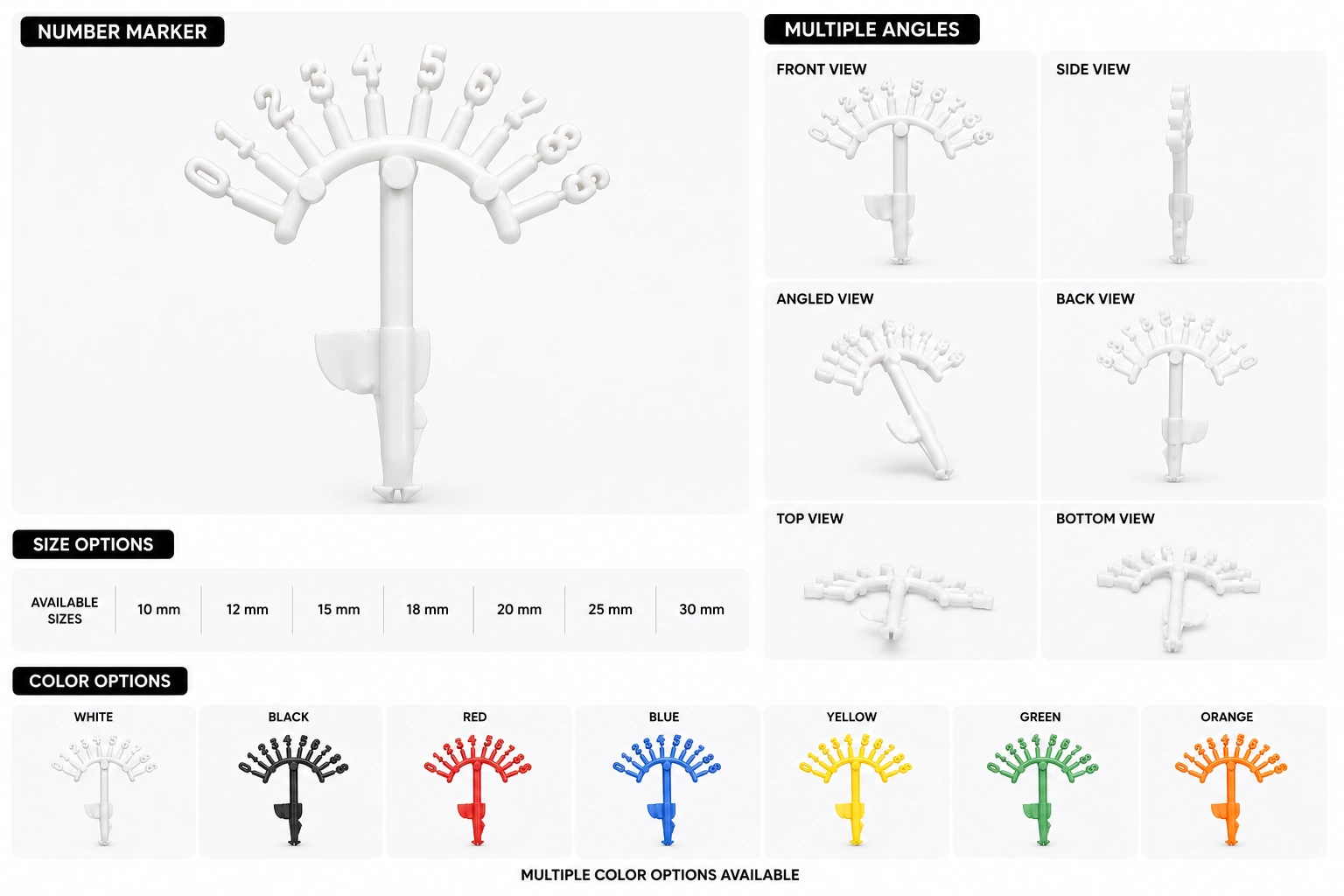
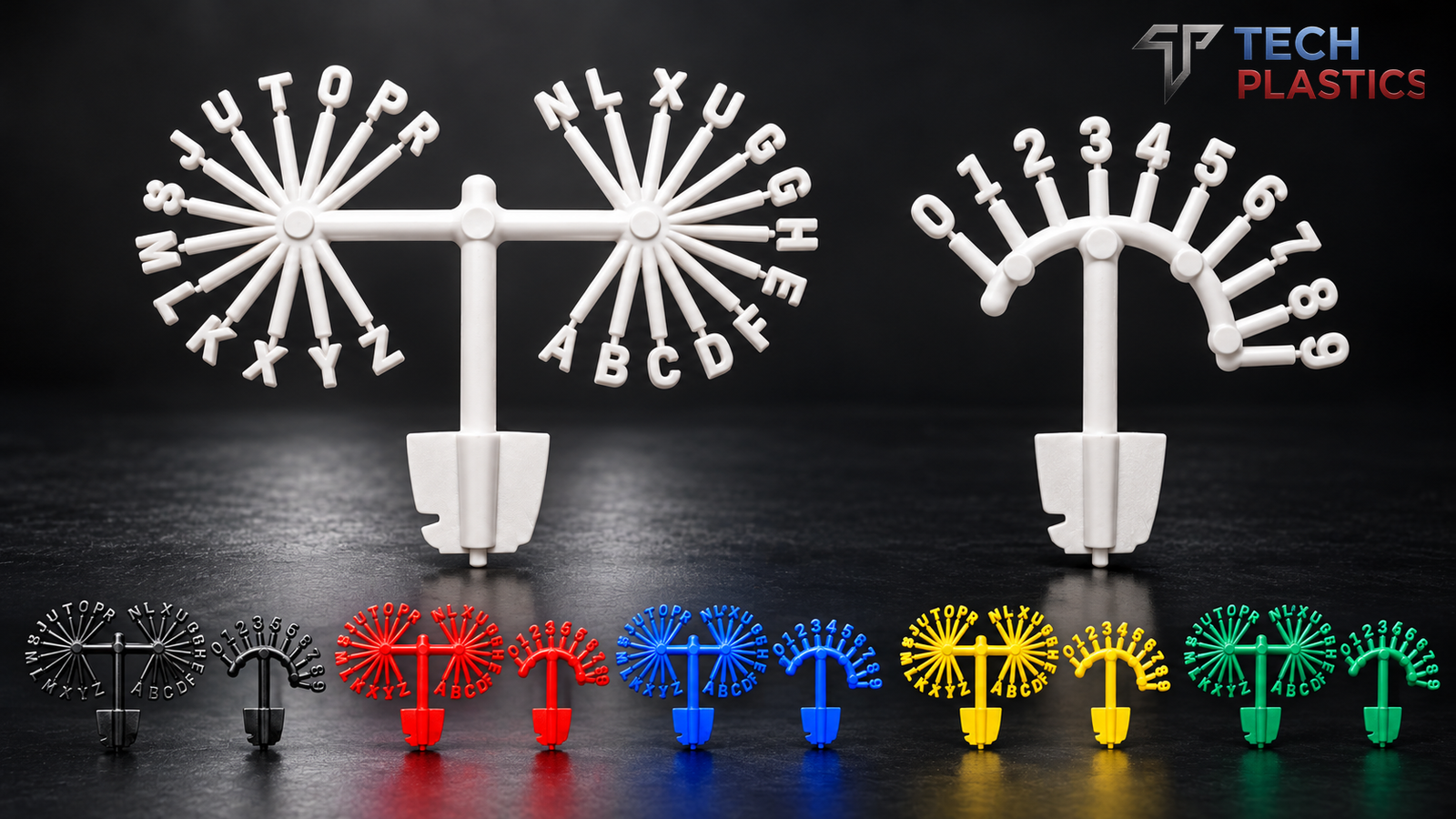
Plastic foundry letters used in iron casting work are essentially the same product family used across the foundry industry — injection-moulded plastic alphabets (A–Z) and numerals (0–9), supplied as sets, with proper draft and a clean raised face suitable for sand moulding.
What matters in iron casting specifically:
- Robustness. CI and SG iron patterns are often used daily for very long production runs. The plastic character has to hold its edges across many hundreds or thousands of mould cycles.
- Clean draft. Iron foundries typically use green sand or no-bake processes with higher ramming pressures than, say, investment casting. Poor draft on the character means torn sand and broken mark edges.
- Consistent profile across repeat orders. A SG iron pump body produced for five years will cycle through several replacement letter sets. All of them have to match.
Our earlier blog on plastic letters manufacturing in India covers the moulding side of how these characters are produced in volume.
How pattern lettering becomes the casting mark
The chain from character to casting mark in a CI or SG iron pour is:
- The plastic character sits on (or in) the pattern
- The sand picks up the shape in reverse
- Molten iron fills the mould and reproduces the raised or recessed mark in iron
- The casting is shaken out, shot blasted and fettled
- The mark survives (or not) into the final inspected casting
A few CI/SG-specific points at each stage:
- Surface finish. CI and SG iron castings have an inherently rougher as-cast surface than, say, pressure die castings. A thin, delicate character disappears into the surface noise. Characters for CI and SG iron work are usually chosen with a healthy stroke thickness so the mark reads clearly after shot blasting.
- Shot blasting intensity. Iron castings often receive aggressive shot blasting to remove sand and surface oxide. A raised casting mark with a flat face and clean draft survives this. A character with no draft or a thin stroke can be flattened or scoured off.
- Painting. Many iron castings are primed and painted. A heavy paint film buries thin lettering. Raised, well-defined characters survive paint; recessed thin characters often do not.
Surface, size and spacing for iron castings
Practical guidance from iron foundry pattern shops:
- Minimum useful height on rough CI surfaces is usually around 8–10 mm. Smaller characters often disappear after shot blasting on a sand-cast iron surface.
- Stroke thickness should be on the heavier side of the plastic-letter range for CI and SG iron work, so the mark remains legible after fettling.
- Spacing should allow enough sand bridge between characters to survive the moulding pressure typical of green sand and no-bake processes.
- Raised marks on the casting (recessed characters in the pattern) are generally preferred for CI and SG iron because they resist paint fill better and are easier to read on rough surfaces.
These are shop-practice observations, not a universal rule — the final specification is always set by the casting drawing and the pattern maker.
Suitability for different pattern types
Plastic foundry letters are used across the common pattern types in Indian iron foundries:
- Wooden patterns — plastic letters are typically glued or lightly pinned; best for medium-volume work and prototyping
- Aluminium patterns — plastic letters are set into shallow milled recesses so they remain positionally stable across many cycles
- Resin and composite patterns — plastic letters bond well to resin surfaces with the right adhesive
- Match-plate patterns — characters are set into pockets or securely bonded so they survive the mechanical cycles of a semi-automated moulding line
- Core box lettering — used where the identification has to appear on an internal feature of the casting
In every case the plastic letter is the same consumable; the pattern maker's fixing method varies.
Maintenance and replacement
Even a well-fixed plastic character does not last forever on a pattern that moulds daily. Realistic maintenance practice looks like:
- Visual inspection of pattern lettering as part of each pattern's periodic maintenance check
- Immediate replacement of any character that has chipped, cracked, lost a corner or come loose; a worn character degrades the casting mark on every subsequent piece
- Keep a reference master set of each height in use, so replacement characters match the originals in profile
- Record the supplier and specification against each pattern so replacements are ordered from the same source where possible
Many CI and SG iron shops absorb pattern-letter replacement into their regular pattern maintenance budget rather than treating each incident as a surprise cost — a sensible approach given how predictable the wear pattern is.
Ordering mistakes we see most often
- Choosing a letter height too small for the casting's as-cast surface. The mark reads perfectly on the pattern and vanishes on the finished casting.
- Mixing suppliers across replenishment orders. The second supplier's "15 mm" is not identical to the first supplier's "15 mm" in stroke or profile.
- No extras for repeat numerals. Date codes consume 0s, 1s and 2s faster than other digits.
- Not confirming draft. Characters without proper draft tear the sand and leave broken-looking casting marks.
- Treating pattern-letter orders as a one-off. For CI and SG iron work, these are a repeating consumable; it is worth setting up a continuing arrangement with one manufacturer.
Sourcing from Tech Plastics
Tech Plastics manufactures plastic foundry pattern letters and numbers at its Moshi, Pune facility using plastic injection moulding processes documented under an ISO 9001:2015 quality system. The company also handles insert moulding and precision engineering components for OEM customers; the same discipline of PO review and batch consistency applies to pattern-letter orders.
Important scope clarifications for iron foundry buyers:
- Tech Plastics does not manufacture CI, SG iron, aluminium or any other metal castings. There are no competing interests in your casting operation.
- Tech Plastics does not operate pattern shops. The role is strictly to supply the plastic lettering products that your pattern maker uses.
- Tech Plastics does not offer 2K injection moulding.
For a first enquiry, share with the Pune team the required character heights in mm, the character list and quantity per character, a photograph or physical sample of any existing reference letter you want the new set to match, preferred colour if any, and the delivery address with vendor-onboarding requirements.
Running CI or SG iron casting patterns and need plastic lettering sets you can rely on across repeat moulding cycles? Share the character list, heights and quantities with Tech Plastics in Pune. The team will review the requirement and come back with a quotation and sample option.