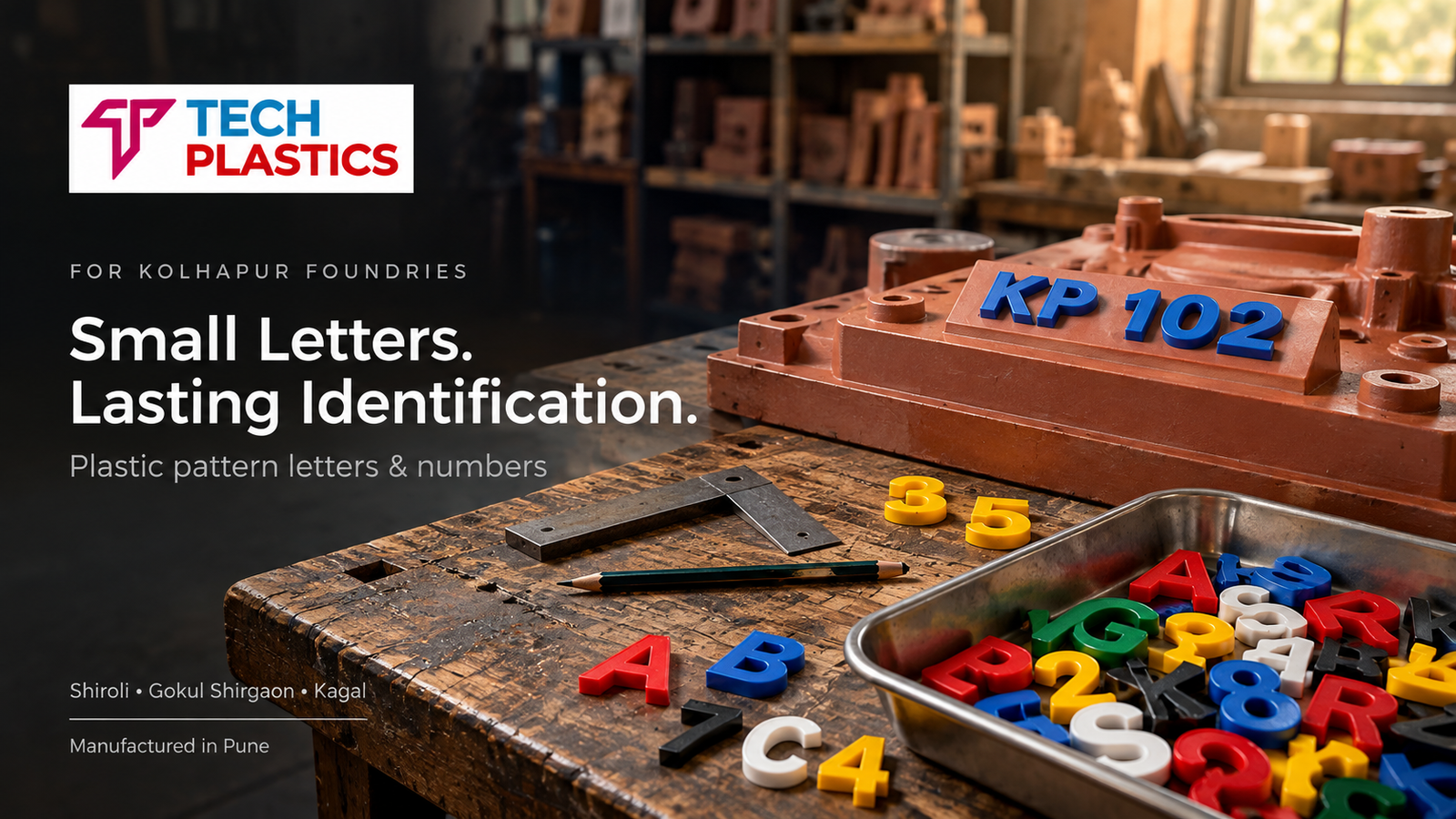
Walk into any working foundry in Pune, Kolhapur or Rajkot and look at a finished casting lying in the finishing bay. Somewhere on it — usually on a flat face near the parting line — you will see a raised part number, a cavity reference, a casting date, and the foundry's own two-letter mark. Those marks are not stamped afterwards. They are formed into the mould by small plastic characters glued or pinned to the pattern.
Those characters are what the trade calls foundry pattern letters and numbers. They are one of the quietest consumables in a pattern shop — rarely discussed in meetings, consistently reordered, and surprisingly critical to traceability on every casting that ships.
This guide is written for foundry owners, pattern makers and purchase teams in India who are about to raise an enquiry for a fresh set and want a clear reference first.
What foundry pattern letters and numbers actually are
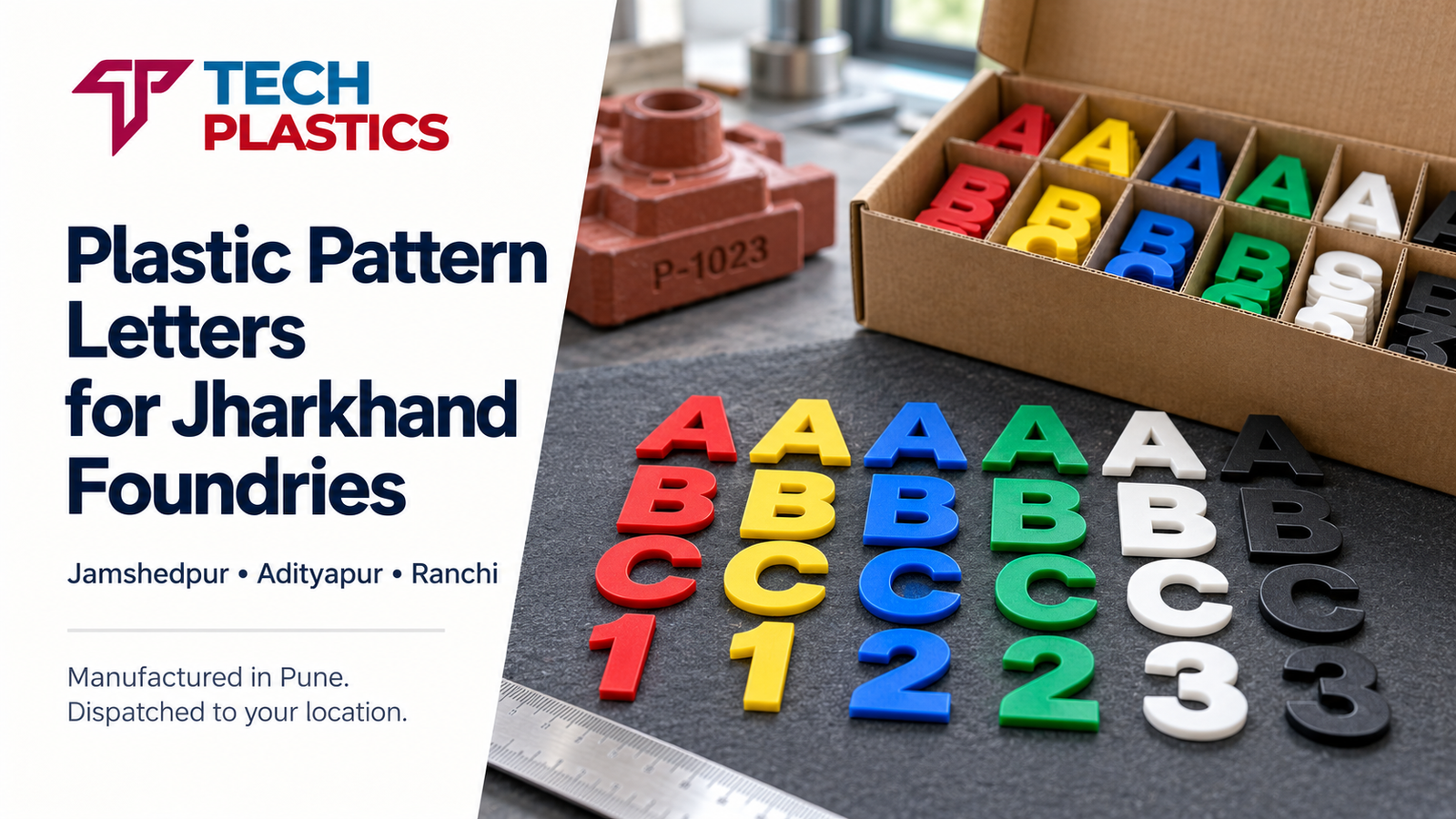
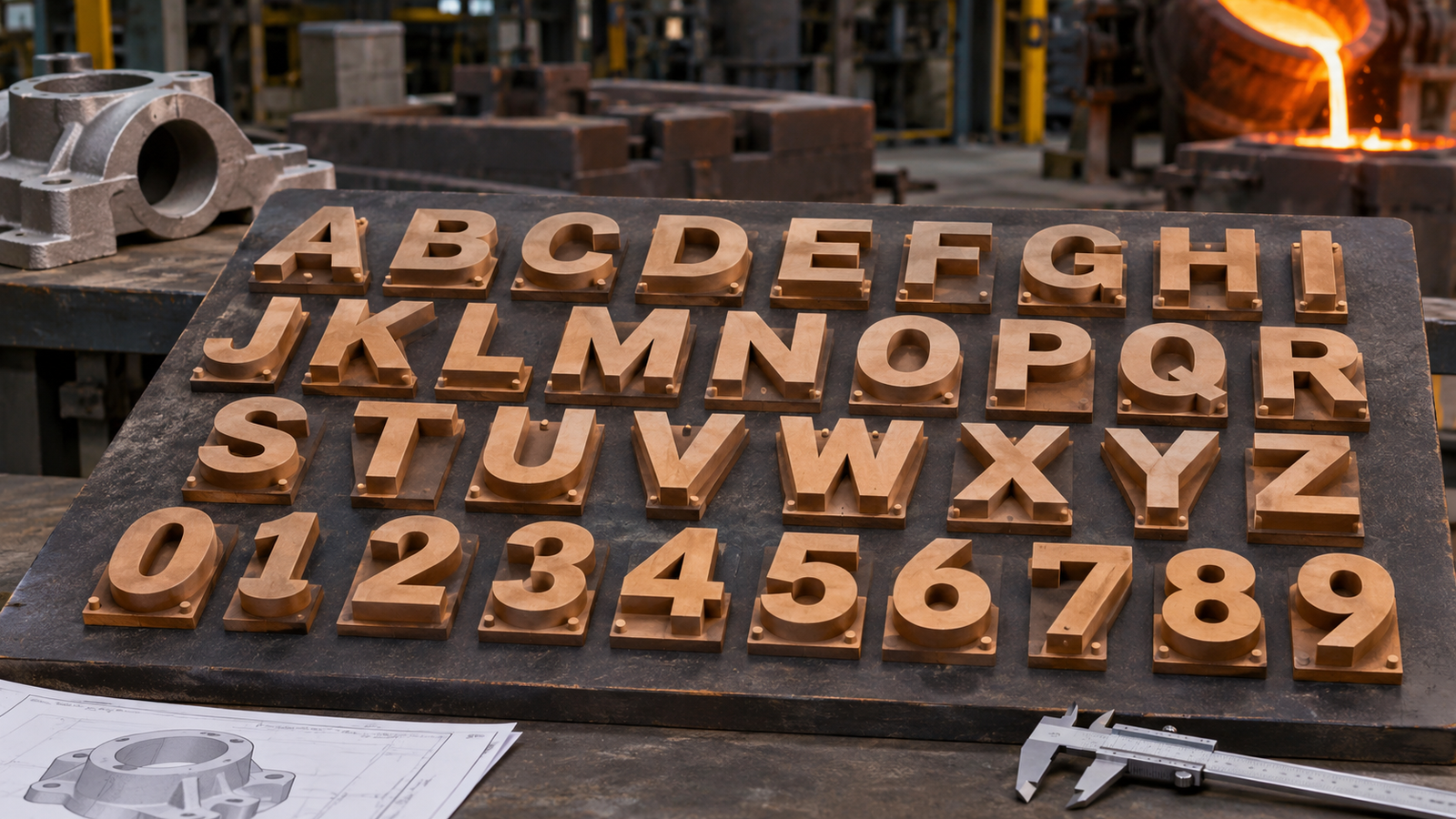
A standard pattern letter set is a tray of pre-formed plastic characters — A to Z, 0 to 9, plus a few common symbols — moulded in a single height, with proper draft on the sides and a clean raised face. The pattern maker picks the characters needed for a given casting, lays them out on the pattern, and fixes them with glue, pins or by seating them into a shallow milled pocket.
When the sand is rammed over the pattern, it picks up the shape of each letter in reverse. When iron is poured, the raised plastic letter on the pattern becomes a raised (or recessed) letter on the finished casting. Instead of hand-carving each pattern, the shop keeps standard sets in two or three heights and reuses them across jobs.
Where they are used across Indian foundries
Pattern lettering appears on almost every category of sand casting produced in the country:
- Automotive castings — engine blocks, cylinder heads, gearbox housings, brake drums, flywheels, differential cases
- Pump and valve bodies — body, bonnet, impeller, cover
- Agricultural castings — tractor housings, pulleys, hitches
- Industrial machinery — gear boxes, bearing housings, machine beds
- Pipe fittings, manhole covers, grates and infrastructure castings
- Electrical housings and switchgear bodies cast in iron or aluminium
In each one, the pattern maker uses the same standard character set to form the part number, grade, cavity number, pattern reference, and often the foundry's own identification mark. For a tier-1 automotive supplier in Chakan or Jamshedpur, that mark is what the receiving inspection reads first.
Why the character on the pattern matters so much
Whatever defect sits on the plastic character is going to sit on every casting that pattern produces — often for the next ten years. A clean, consistent character with the correct draft gives you a casting mark that:
- can be read on the shop floor without a magnifier
- survives shot blasting and painting
- holds up through pattern storage and repeated moulding cycles
- stays legible after the pattern has moulded tens of thousands of boxes
If the character is poorly made, the mould releases badly, sand sticks, and the resulting casting mark looks washed out or broken. That is not a cosmetic problem — it is a traceability problem. A part number no one can read is a part number no one can audit later when a field complaint comes back.
Plastic letters versus other options
Pattern makers have historically used several materials:
- Metal type letters — brass or type-metal characters that were common decades ago. Durable but heavy, costly and hard to replace in small quantities.
- Wooden letters — carved or routed; mostly used for very large characters where plastic sets are not available.
- Dymo or embossed strip — adhesive-backed tape with punched characters. Cheap and quick, but short-lived and limited in height.
- Plastic foundry letters — injection-moulded in engineering plastics, supplied as full A–Z and 0–9 sets.
Plastic has become the default in most Indian pattern shops for three practical reasons: it is light enough not to distort the pattern, it holds a consistent profile across the whole character set, and it is affordable to re-order one height at a time when a set wears out or gets misplaced.
For a broader shop-floor view of how these characters are produced in volume, we have covered the manufacturing side in Plastic Letters Manufacturing in India and in the Pune-specific Premier Plastic Numbers Manufacturer in Pune.
What a buyer should ask for on the first call
When a pattern shop or foundry purchase team raises an enquiry, these are the questions a good supplier will walk through:
- Character height — 6 mm, 10 mm, 12 mm, 15 mm, 20 mm, 25 mm, or custom
- Full set or partial — complete A–Z plus 0–9, or specific repeat characters only
- Font and profile — a plain block sans-serif is standard; a bolder stroke is sometimes requested for rough iron surfaces
- Material and colour — usually a flat single colour so the characters stand out against a wooden pattern
- Draft angle — the sides must taper slightly so the sand releases cleanly
- Attachment method — glued, pinned, or set into a milled pocket
A supplier who has made these parts before will raise all of these on the first call. If they don't, the first batch usually comes back with the wrong profile.
Letter height, stroke and readability
For most Indian iron and SG iron castings, the pattern letter height is matched to the available flat surface on the casting and the viewing distance on the shop floor. A rough working guide used in many foundries:
- Small cast parts (pump covers, small housings): 5–10 mm
- Medium automotive and industrial castings: 10–15 mm
- Large castings (manhole covers, large pump bodies, flywheels): 20–30 mm or more
Stroke thickness should be proportional. A thin stroke on a rough iron surface disappears into the texture; an over-thick stroke traps sand and distorts during moulding. A more detailed treatment of sizing is covered in our companion article on Choosing the Right Size of Foundry Pattern Letters and Numbers.
Positioning and attachment on the pattern
A few rules the pattern shop usually applies:
- Letters sit on a flat or nearly-flat area of the pattern, well clear of edges and parting lines
- Spacing is kept wide enough that the sand between characters does not collapse during stripping
- The lettering face is kept parallel to the parting plane so draft works correctly
- The adhesive or pin fixing has to survive ramming pressure and repeated stripping
For match-plate or CNC-moulded patterns, foundries often prefer characters seated into a milled recess so they do not get knocked out of alignment over time.
Planning quantity and repeat orders
A working foundry rarely orders a single alphabet set. The typical pattern looks like:
- One or two full A–Z + 0–9 sets per common character height, kept at the pattern shop
- Extra quantities of the most-consumed numerals — 0, 1, 2 and the current and next year's leading digits for date stamps
- Replacement letters for characters that chip, break or get lost through handling
- New-height orders when a casting with a different drawing specification comes in
A good supplier keeps a record of what you have purchased before, so a repeat enquiry does not need to re-explain the full specification each time.
Common mistakes when ordering
Mistakes that cost foundries time and money, roughly in order of how often we see them:
- Ordering only the character height, not the profile. Two sets of "10 mm letters" from two suppliers can look very different in stroke and draft.
- Mixing heights across one casting. Part number characters and heat code characters at different heights produce an inconsistent casting mark.
- Underestimating repeat numerals. Date and heat codes burn through 0s, 1s and 2s much faster than other digits.
- Skipping sample approval. For a new height or new supplier, approving a physical sample before the full set is manufactured avoids rework.
- Vague specifications on the PO. "Plastic foundry letters" alone is not enough — the PO should name height, character list, quantity, font/profile and material.
Requesting a quotation from Tech Plastics
Tech Plastics manufactures plastic foundry pattern letters and numbers at its Moshi, Pune facility using the same plastic injection moulding capabilities that produce precision engineering components for OEMs. The scope of supply to foundry customers is strictly the plastic letters themselves — Tech Plastics does not manufacture iron, steel or aluminium castings, and does not operate pattern shops.
To get a workable quotation, share the following with the Pune team:
- Required letter and number heights, in mm
- Full character list and quantity per character
- Preferred colour, if any
- Any existing sample or reference you want the new order to match
- Delivery location and vendor-onboarding paperwork, if required
Need plastic letters and numbers for foundry pattern work? Share your required letter height, character list and quantity with Tech Plastics in Pune. Our team will review the requirement and come back with a quotation.